
IVYH Journal
Sodium and salt in electrolyte powders: how to read the label
Learn the difference between sodium and salt, convert the amounts, and compare electrolyte powders per serving and prepared drink, with clear worked examples.

In this guide
Sodium and salt are not the same amount. On EU nutrition labels, salt content is calculated by multiplying sodium by 2.5. That means 400 mg of sodium is equivalent to 1 g of salt. To compare two electrolyte powders, you also need to check whether the figure is per serving, per 100 g of powder or per quantity of prepared drink. 1
This guide explains the units and calculations. Every worked example is hypothetical: none is a test result, an IVYH product quantity or a recommended serving size.
Why does one label say sodium and another say salt?
Sodium is a chemical element. Table salt, or sodium chloride, contains sodium and chloride. The “salt” figure in an EU nutrition declaration is a calculated salt equivalent: all the sodium in the food is multiplied by 2.5. Sodium from ingredients other than added table salt counts too. So the salt figure does not tell you exactly how much table salt the manufacturer added. 1 2
You cannot compare 400 mg of sodium with 400 mg of salt as though they were the same thing. First convert both figures to the same substance and unit.
How to convert sodium to salt
The formula is salt = sodium × 2.5. Keep the same unit of weight on both sides. To convert milligrams of sodium into grams of salt, multiply by 2.5, then divide by 1,000. 1
- 200 mg sodium × 2.5 = 500 mg salt, or 0.5 g.
- 400 mg sodium × 2.5 = 1,000 mg salt, or 1 g.
- 600 mg sodium × 2.5 = 1,500 mg salt, or 1.5 g.
To go the other way, divide the salt amount by 2.5. One gram of salt is equivalent to 0.4 g, or 400 mg, of sodium. These calculations are not serving-size recommendations.
Compare servings, not just the biggest number
Two packs may present their figures differently. One might show the amount per sachet, another per 100 g. A bigger number per 100 g does not necessarily mean more sodium in a prepared serving.
Suppose a powder lists 8 g of sodium per 100 g, and one serving weighs 5 g. That serving contains 8 × 5 ÷ 100 = 0.4 g of sodium. That is 400 mg of sodium, equivalent to 1 g of salt. Again, this is a hypothetical calculation, not a product specification.
Check:
- Does the figure refer to sodium or salt?
- Is the unit grams or milligrams?
- Is it for dry powder, one serving or the prepared drink?
- How big is the serving, and how much water do the instructions specify?
For foods covered by the standard mandatory EU nutrition declaration, values are given per 100 g or 100 ml; per-serving information can be added. Food supplements are exempt from that standard declaration requirement and are governed by a separate EU framework. Do not assume every electrolyte product must display an identical table. 2 3 4
What changes when you add more water?
More water changes the concentration, not the amount of sodium supplied by the powder. For a hypothetical serving containing 400 mg of sodium, assume the water adds no sodium and the final prepared drink volumes are:
- 500 ml: 80 mg sodium per 100 ml.
- 1 litre: 40 mg sodium per 100 ml.
If you drink the whole mixture, you get 400 mg of sodium from the powder in either example. If you drink half of the evenly mixed litre, you get half that amount, or 200 mg. That is why both the serving amount and the mixing instructions matter when comparing labels.
Is more sodium always better?
No. A content figure tells you the amount, not whether a product is right for you. Different sodium amounts alone do not prove that one product works better than another. This guide does not assess your electrolyte needs or tell you how much salt to consume.
Dietary reference values are not personal dosing instructions either. EFSA explains that these values provide a scientific basis for uses such as dietary guidelines and food labelling; they are not nutrient goals or recommendations for individuals. 5
Using this guide when looking at IVYH
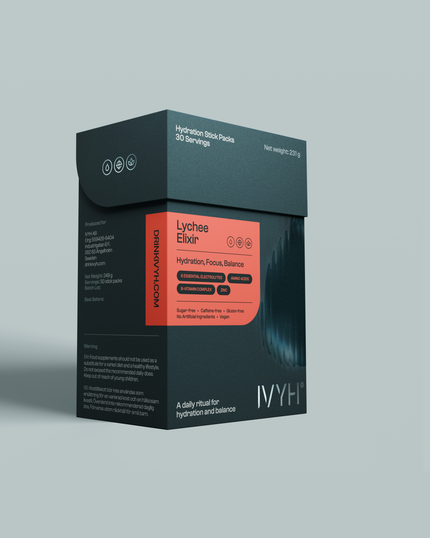
Open the IVYH product page and read the current content information alongside the packaging label. The IVYH FAQ covers use and mixing. IVYH comes in sachets that are mixed with water.
Keep the sodium amount, the calculated salt equivalent and any combined mineral totals separate. A total electrolyte figure is not automatically the sodium amount. If a table is unclear, ask for clarification rather than guessing.
Common questions about sodium and salt
How much salt is equivalent to 1,000 mg of sodium?
Using sodium × 2.5, 1,000 mg of sodium is equivalent to 2,500 mg, or 2.5 g, of salt. 1
Can I add the sodium and salt figures together?
Not if the salt figure has already been calculated from the sodium amount. You would be counting the same sodium twice. Check how the table is set out before adding anything together.
Can I compare a powder with a ready-to-drink product?
Yes, but compare the same volume of prepared drink or an equivalent serving. A figure per 100 g of dry powder cannot be compared directly with one per 100 ml of drink.
Sources
- European Commission, Knowledge4Policy: Dietary Salt/Sodium. Sodium, salt and the EU conversion factor.
- Swedish Food Agency, Kontrollwiki: Nutrition declaration (in Swedish). Total sodium sources, salt calculation and the food-supplement exemption.
- European Commission: Nutrition labelling. Standard EU nutrition declarations per 100 g or 100 ml and optional per-serving information.
- European Commission: Food supplements. The separate EU framework under Directive 2002/46/EC.
- EFSA: Dietary reference values. What reference values are used for and why they are not individual recommendations.